This summer I received a Mel Horwood Bursary, which meant I could attend two day-long workshops at People Dancing’s Summer Programme: NYB All In! – Introduction to Accessible Ballet Practices with National Youth Ballet, and Producing, Co-creation & Inclusion in Performance for Children with Second Hand Dance.
I am incredibly grateful as this isn't something I often get to give myself.
Most of the time, I am the person running the workshop, directing the rehearsal or teaching the class. Like lots of freelancers, I move from one contract to the next while also trying to work out where the one after is coming from, so there was something quite special about travelling to Leicester and, for two days, just being an artist in a room with other artists.
I didn't have to deliver anything. I could dance, play, ask questions, talk to people between sessions and properly take things in. I got to travel and spend time with other artists doing professional-level work, with the space to actually enjoy it.
I hadn't realised quite how much I needed that.
The bursary also came at an interesting point for me. I had recently completed an Arts Council England Developing Your Creative Practice project. Part of that journey became about trying to understand my own process. I have been directing, performing, choreographing and facilitating for years, and there are lots of things I do instinctively without necessarily being able to explain them.
My DYCP had got me asking: What actually is my process? These two days made me start asking another question: Why does it matter that I know?
The first day with National Youth Ballet put me properly back into the experience of being a dancer in training.
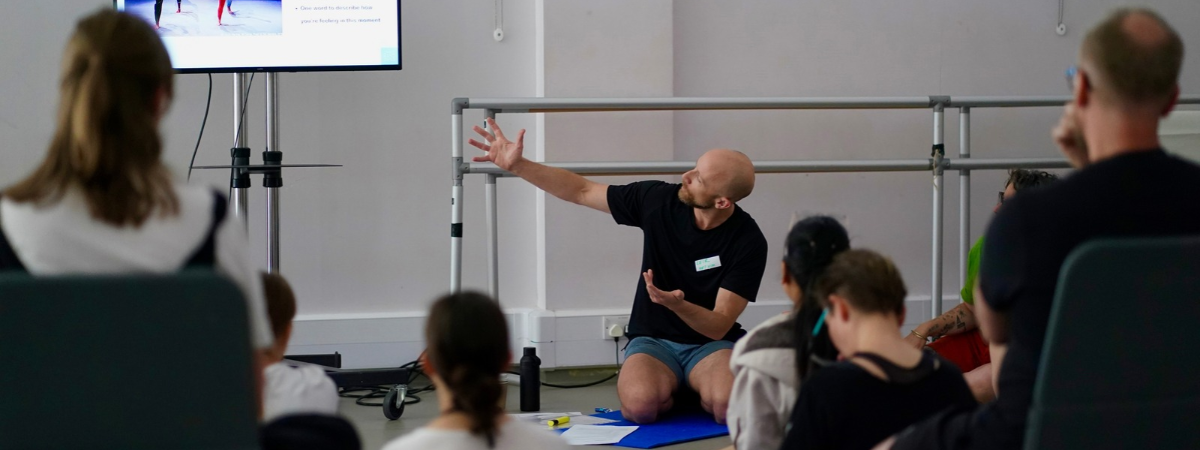
It was a very practical day, and we were moving for a lot of it. What interested me was how much was built into the way the workshop was delivered. Demonstration, images, video and projection, explanation and creative exploration all sat alongside the physical training.
That made me think differently about my own ballet training. I have around six years of it, yet there are still ballet movements and terms that I don't confidently know. I've probably always put that down to me. I simply didn't retain it.
The pace of the NYB workshop, at times, felt very similar to being back at college. What was different was what I had available to me while I was trying to learn.
When I trained, I was taking in the name of the movement, where my arms and legs went, musicality, technique and corrections, all while trying to actually do the thing. When I didn't understand something, I knew one question: “Can you show me that again?” What I don't remember knowing was that I could ask:
- Why?
- What am I actually trying to achieve?
- What is the important bit?
- Can you explain it another way?
That has really followed me back into my own teaching.
I'm starting new dance classes now, and I want the young people I work with to know that:
“Can you show me again?” isn't the only question available to them. More importantly, I want to start building different routes into my teaching from the beginning, rather than waiting for somebody not to understand and then finding another way.
That puts some of the work back onto me as the teacher.
If I'm teaching choreography, I need to have done the work beforehand. I need to understand why I've made a particular choice and what I'm actually trying to achieve with it. Then I can think about how else I might demonstrate it, explain it, give it imagery, show it visually or let somebody explore it physically. Hopefully, then people don't always have to ask for another way in because some of those different ways are already there.
And when somebody does need to ask, I have more to offer than simply repeating the same demonstration. That takes more work from me before I enter the room. But it also gives me more freedom once I'm actually in it.
That is probably the biggest thing I took from the National Youth Ballet day; not a collection of teaching techniques, but a challenge to raise the level of my own preparation.
Then came Second Hand Dance…
And suddenly I wasn't only thinking about how I teach. I was looking at ‘how I work’.
That is where this started to feel much bigger and, if I'm honest, a little scary, because once I started looking at my whole practice through that lens it opened up questions about almost everything.
The funny thing though is that the workshop itself was full of joy. We played. A lot!
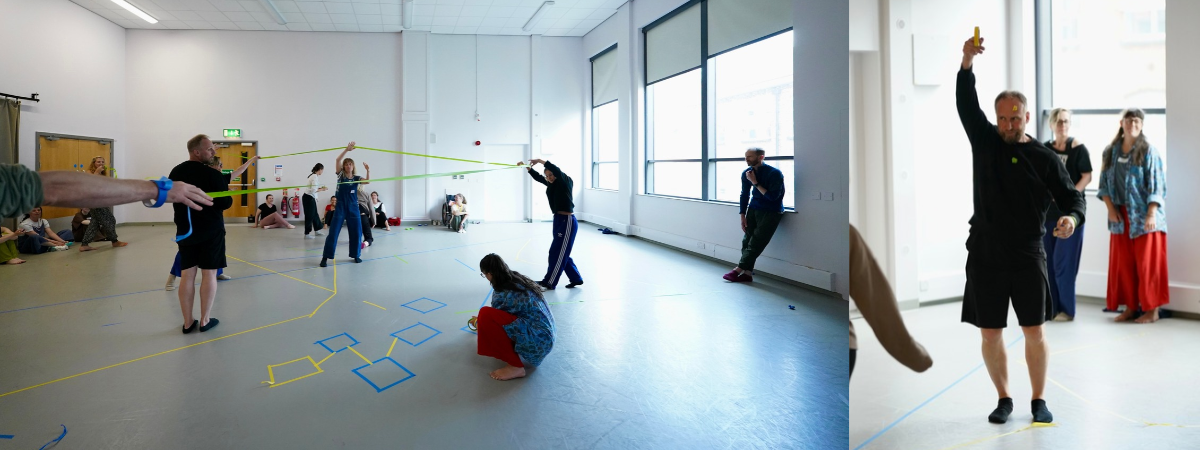
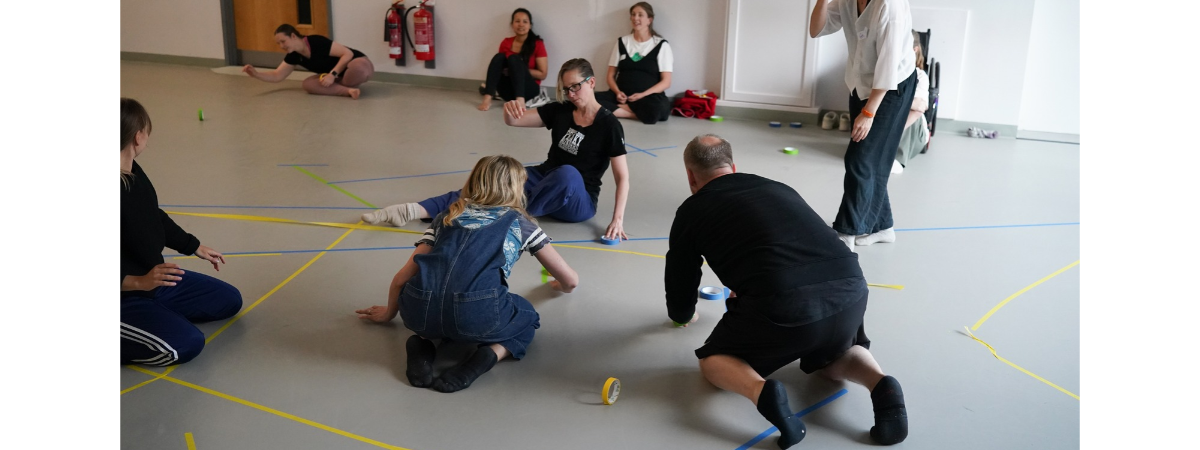
We worked in groups using sticky tape from Second Hand Dance's The Sticky Dance. Things started happening.
Motifs appeared. Relationships developed. Something one person did was picked up by somebody else. Interactions started happening between half the group who were performers for an audience of the other half. It felt free, funny, playful. At the same time, I felt like I was seeing a really high professional level of work.
And underneath all that play, loads was happening.
We were watching. Waiting. Reading each other. Making offers. Judging how close to get. Deciding whether to follow something or change it. Thinking about touch. Picking up movement. Letting things go.
And the better it worked, the less you could see all of that thinking.
It just looked like play. That really got me. There are skills that, when somebody gets very good at them, almost disappear; become undetectable. And I suddenly thought about how much of my own work I describe as: “It's just what I do.”
The freedom came from the structure underneath it.
If Second Hand Dance had arrived in the room that morning and simply given us the tools – mirroring, proximity, touch, adding to somebody else's offer – I don't think we would have got anywhere near what happened later.
The whole day had taken us there.
We had tried things. Watched. Talked. Reflected. Swapped roles. Experienced what things felt like from different positions. By the time we were given the freedom to play, there was a shared understanding underneath it.
And that's when the two days really started connecting for me.
With National Youth Ballet, I had been thinking about what I need to put in place before I teach something. Second Hand Dance made that question much bigger.
Their methodology seemed to travel through everything: how they worked with children, how artists entered a space, how they observed, how they prepared people, how they reflected and how they communicated. It even reached into how they structured the company and cared for the people doing the work. They talked about the working week, reflection, rest and adapting the organisation around the needs of the people within it.
I found that really interesting.
The care for the artists wasn't something separate from achieving a high level of work. It was part of what allowed them to keep doing that work over the long term.
Through my DYCP, I had started identifying my own methodology. I don't think I had fully understood why I needed to articulate it. Second Hand Dance started to show me why.
I've been doing this work for a long time.
I can walk into a room and usually get a feel for it quite quickly. I change plans. I read people. I know when to push and when something needs more time; I use movement, rhythm, games, improvisation and stories. Years of doing the work have built instincts that I trust.
I don't suddenly think I've been working wrongly all these years. I think I was already doing lots of this without having this particular lens to look at it through. Now I can see more of what might be sitting underneath those instincts.
And that matters.
- If I say, “It's just what I do,” how does another artist understand what I need from them?
-
If I'm going into a school, can I explain what we need to do our best work?
-
If I'm asking a theatre to support something, do they understand why I need to work in a particular way?
-
If I'm applying for funding, can I explain not only what I want to make, but how I want to make it, why I work that way and what that process needs?
I think there is something empowering about being able to articulate that.
The methodology isn't something that sits behind the project.
It is part of the project.
And I can already see this changing the way I think about work I'm developing.
I'm currently working towards a project around Norfolk folk nights and pubs. My instinct has been to go into pubs, meet people, hear stories, experience the music and atmosphere and allow all of that to feed into what we eventually make.
Hearing how Second Hand Dance develop work in nurseries made me look at that instinct differently. The pub isn't somewhere I visit to collect research and then leave before the “real” creative process starts. The pub is part of the rehearsal room. The conversations, the people, the music, the interruptions and the atmosphere are part of making the work. If the last pub we visit gives us the dream story that changes the whole thing, I want the process to be able to change with it.
That's part of how I make work. Being able to understand and say that feels important.
A tipping point…
None of this has made me think that the way I worked before was wrong. I've built my practice over years of directing, performing, choreographing, teaching and facilitating. Everything I've done has brought me here. I have experience and instincts that I value and trust. What these two days gave me was a different lens through which to look at all of that.
And that feels quite life-changing.
I don't mean that I've come home and thrown out everything I used to do. Almost the opposite.
I'm looking at what I already do and asking more questions of it:
- Why do I do that?
- What makes it work?
- What needs to be in place for it to work at its best?
- What could I prepare before I enter the room?
- What needs to stay open so I can respond when I'm there?
- Who else needs to understand the way I'm working?
- And what needs to be around me so I can keep doing this work over a whole career?
Now I've started looking through that lens, I don't think I can go back.
That's exciting. It also gives me some challenges.
I am a freelancer. Time can be tight. One job can run straight into another. So how do I build in this level of preparation? How do I make proper space for reflection? How do I articulate my methodology without fixing something that needs to remain responsive? How do I create good conditions for the artists and young people I work with while also making those conditions sustainable for me?
I don't have the answers to all of that yet.
And maybe that's why this feels like a tipping point rather than a conclusion.
I'm not starting again. I'm looking at years of experience with a new understanding of what is underneath it, what supports it and what might be possible if I give those things more thought and care.
I don't know where all this will end up. It is already coming into my teaching, the R&D I'm planning and the way I'm thinking about my own projects. In a few years, who knows?
It doesn't feel like I'm learning how to become an artist. It feels like I'm starting to understand more of the full picture of what it means to build a life and a career as one.
And I'm genuinely excited to see where that takes me.
I am hugely grateful to People Dancing, National Youth Ballet and Second Hand Dance for these two days, and especially to the Mel Horwood Bursary and Mel's family for giving me the opportunity to be there. As a freelancer, having the time and support to stop delivering, become the learner again and spend two days surrounded by other artists was incredibly valuable.
I have a feeling I'll be carrying these two days with me for quite a while.
Information
www.bennash.co.uk
bboy_neviz